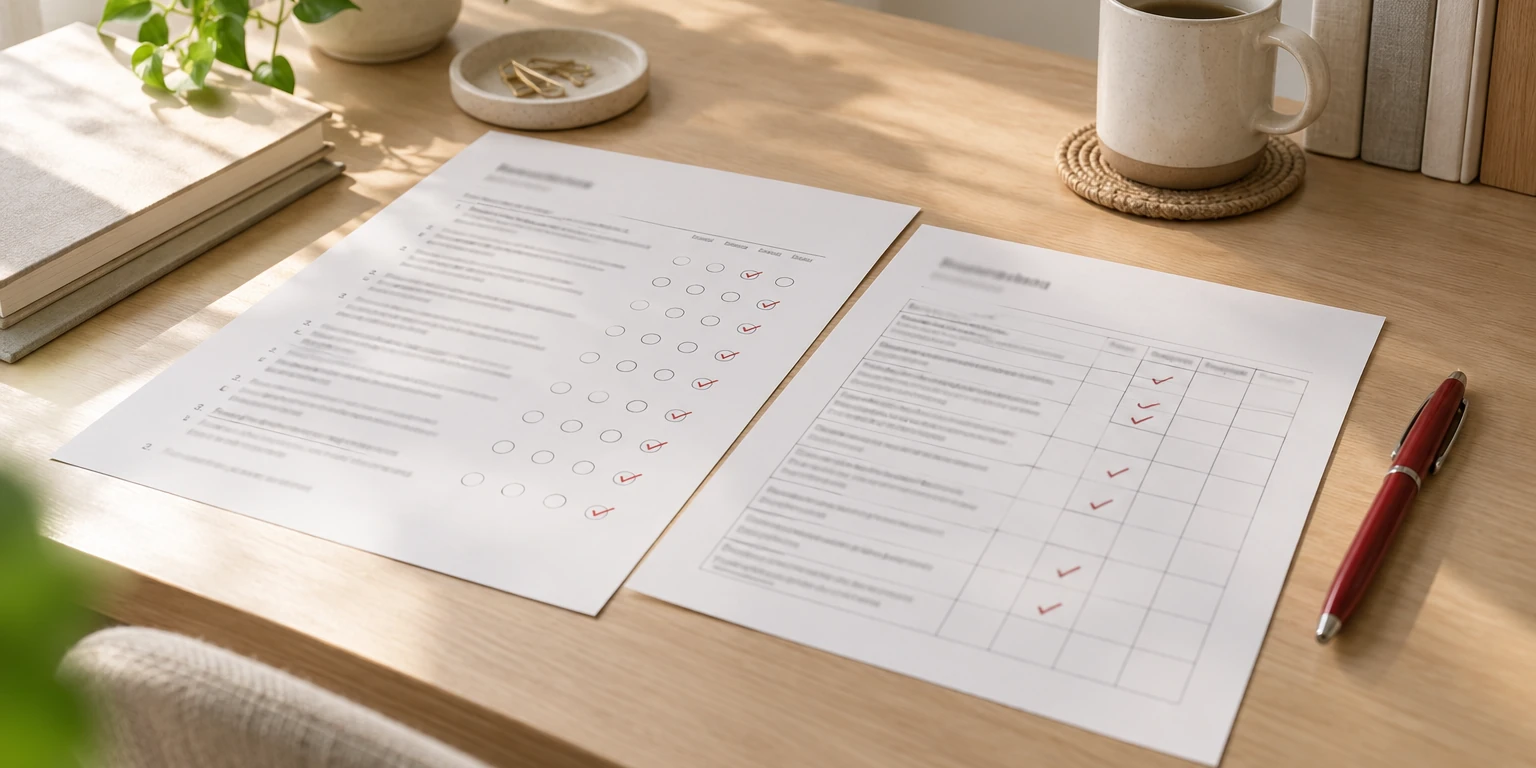
How to create surveys for academic research
Reviewed: August 19, 2026. Sources, review and corrections methodology
DIRECT ANSWER
Practical guide to designing effective research surveys. Question types, instrument validation and free tools.

Surveys are a common option in quantitative research, but they are not appropriate for every problem. Designing a good survey is more than writing questions: it requires defining variables, population, validity evidence, procedures and analysis before collecting data.
A poorly designed survey generates useless data. And with useless data, no analysis or conclusion can save your thesis. This guide takes you from survey types through statistical validation, with concrete examples and the tools you'll need.
Types of surveys by structure
Before designing questions, you need to decide what kind of survey you're building:
| Type | Description | When to use | Example |
|---|---|---|---|
| Structured | Closed questions with predefined options; every respondent answers the same items | Quantitative research; when you need comparable, measurable data | Satisfaction survey with Likert scale |
| Semi-structured | Combines closed questions with some open-ended ones | Mixed methods; when you need quantitative data plus depth | Survey with "Rate from 1 to 5" plus "Explain your answer" |
| Unstructured (open) | Only open-ended questions; responses are free-form | Exploratory qualitative research; when you don't know the phenomenon well | Exploratory questionnaire to identify perceptions |
Most theses in Honduras use structured or semi-structured surveys. If your approach is quantitative, your survey should be structured. If it's mixed methods, a semi-structured survey gives you the best of both worlds.
Steps to design your survey
1. Define what you want to measure
Before writing a single question, be clear about:
- Your variables — What concepts do you need to measure? (job satisfaction, academic performance, service perception, etc.)
- Your indicators — How is each variable observable in reality? (frequency of use, level of agreement, numerical rating)
- Your population — Who will you survey? (engineering students at UTH, employees at a company, teachers at UPNFM)
- Your specific objectives — Each objective should be answerable with one or more questions from your survey
Tip: Create a variable operationalization table before writing questions. This table connects your variables to their dimensions, indicators, and specific survey questions. Evaluators at UNAH and UNITEC frequently ask for this.
| Variable | Dimension | Indicator | Question | Question type |
|---|---|---|---|---|
| Academic satisfaction | Teaching | Perceived teaching quality | "The instructor explains topics clearly" | 5-point Likert |
| Academic satisfaction | Infrastructure | Adequacy of facilities | "Classrooms have the necessary resources" | 5-point Likert |
| Academic satisfaction | Services | Administrative efficiency | "Administrative procedures are resolved in a reasonable time" | 5-point Likert |
2. Choose question types
| Type | Example | When to use | Strengths | Weaknesses |
|---|---|---|---|---|
| Closed dichotomous | Yes / No | Simple categorical data; screening respondents | Easy to answer and analyze | Doesn't capture nuance |
| Multiple choice | a) b) c) d) | Several predefined options; single answer | Standardized; quick to analyze | May miss relevant options |
| Multiple response | Select all that apply | When the respondent can choose more than one option | Captures complexity | More complicated analysis |
| Likert scale | Strongly agree → Strongly disagree | Measuring attitudes, perceptions, opinions | Most widely used in theses; allows robust statistical analysis | Central tendency bias |
| Numerical scale | From 1 to 10 | Satisfaction, perceived quality | Intuitive for respondents | Subjective; people interpret the scale differently |
| Ranking | Order from most to least important | Prioritizing options | Shows relative preferences | Difficult with many options |
| Open-ended | "Describe your experience..." | Exploring unanticipated responses; getting detail | Rich in information | Hard to analyze quantitatively |
| Direct numerical | "How many hours do you study per week?" | Exact quantitative data | Precise; easy to analyze | Respondent may not remember accurately |
For quantitative theses in Honduras, the 5-point Likert scale is the most common and recommended. It's easy to administer, allows Cronbach's Alpha calculation, and evaluators are very familiar with it.
3. Write the questions
Best practices:
- One idea per question — don't ask two things at once
- Simple, direct language — avoid unnecessary jargon; if you're surveying freshmen, don't write like you're addressing academics
- Neutral — don't lead the answer
- Logical order — group by topics, from general to specific
- Use the same scale consistently — if you use 5-point Likert, keep it throughout
- Avoid double negatives — "It's not true that I don't like..." is confusing
Examples of bad questions and how to fix them:
| Bad question | Problem | Better version |
|---|---|---|
| "Don't you think virtual education is bad?" | Leading and negative | "Virtual education has allowed me to learn effectively" (Likert) |
| "How do you evaluate the quality and efficiency of the service?" | Double-barreled | Split into two: "The quality of the service is adequate" and "The service is efficient" |
| "What do you think about constructivist epistemology?" | Unnecessarily complex | "Teaching methods based on student experience are effective" |
| "Do you always study a lot?" | Ambiguous (what is "a lot"?) | "How many hours per week do you dedicate to studying outside of class?" |
4. Structure your survey
A well-structured survey has four clear sections:
-
Introduction — Who you are, the research purpose, data confidentiality, that participation is voluntary, and estimated completion time. This is an ethical requirement.
-
Demographics — Age, gender, major, university, semester, employment status (depending on what you need). You can place these at the beginning or end — at the beginning they serve as a "warm-up"; at the end they prevent the respondent from abandoning the survey due to personal questions before reaching the substantive content.
-
Main body — Core questions grouped by dimension or variable. Include clear instructions before each section (example: "Below, indicate your level of agreement with the following statements").
-
Closing — Thank you and optional comments space. If you're collecting contact information for follow-up, indicate it here.
Recommended length:
| Context | Number of questions | Estimated time |
|---|---|---|
| In-person survey with students | 15-25 questions | 8-12 minutes |
| Online survey (Google Forms) | 15-30 questions | 5-10 minutes |
| Structured interview | 10-15 questions | 15-30 minutes |
If your survey takes more than 15 minutes, you'll get a high abandonment rate — especially with online surveys.
5. Calculate sample size
Sample size depends on the design, population, desired precision, analysis and resources. A 95% confidence level and 5% margin are common assumptions for simple estimates, not a standard for every study.
General guidelines:
| Population size | Recommendation |
|---|---|
| Under 100 | Survey everyone (census) |
| 100-500 | Minimum 80-120 respondents |
| 500-5,000 | Use the finite population formula |
| Over 5,000 | Use the infinite population formula; typically 384 respondents |
Formula for finite populations:
n = (Z^2 * N * p * q) / (e^2 * (N-1) + Z^2 * p * q)
Where:
- n = sample size
- Z = 1.96 (for 95% confidence)
- N = population size
- p = 0.5 (probability of success)
- q = 0.5 (probability of failure)
- e = 0.05 (margin of error)
Practical example: If you're studying 300 Business Administration students at UTH:
- n = (1.96^2 * 300 * 0.5 * 0.5) / (0.05^2 * 299 + 1.96^2 * 0.5 * 0.5)
- n = 288.12 / 1.7079
- n = 168.7 → 169 respondents
You can also use online calculators like SurveyMonkey's or Raosoft's. Make sure to document the formula and process in your methodology chapter.
6. Validate your instrument
Evidence of instrument quality should match the design and the program rubric. Many studies document content validity and reliability, but the procedure is not universal: agree with your advisor on the appropriate evidence before collecting data.
Content validity — Expert judgment
Select 3 to 5 professionals with experience in your subject area (professors, researchers, field practitioners). Each one reviews your survey and evaluates:
- Relevance — is the question pertinent to the variable it measures?
- Clarity — is the question understandable without ambiguity?
- Coherence — is the question consistent with the dimension it belongs to?
- Sufficiency — do the questions in each dimension cover all necessary aspects?
Typically, each criterion is rated on a 1-to-4 scale. Calculate the concordance index among the experts — agreement above 80% indicates your instrument has good content validity.
Reliability — Pilot test and Cronbach's Alpha
If the design includes a pilot, define a group comparable to the population and justify its size. Do not turn a range used in another study into an automatic rule. With the pilot data:
- Enter the responses into Excel or SPSS
- Calculate Cronbach's Alpha for each dimension and for the overall survey
| Alpha value | Interpretation |
|---|---|
| α < 0.50 | Unacceptable — rewrite the questions |
| 0.50 - 0.60 | Poor — needs serious revision |
| 0.60 - 0.70 | Questionable — acceptable only for exploratory studies |
| 0.70 - 0.80 | Acceptable — the recommended minimum for theses |
| 0.80 - 0.90 | Good — indicates a solid instrument |
| 0.90+ | Excellent — be careful, may indicate redundancy |
If your Alpha is below 0.70, review the problematic questions (SPSS shows you "Alpha if item deleted") and adjust before administering the real survey.
Instrument design is one of our specialized services. We create validated surveys with pilot testing and reliability reports included. Learn about the service.
Digital tools for creating and distributing surveys
| Tool | Cost | Main strength | Limitations | Best for |
|---|---|---|---|---|
| Google Forms | Free | Most accessible; integrates with Sheets for analysis | Limited conditional logic; basic design | Simple to medium surveys; the most popular option among Honduran students |
| Microsoft Forms | Free with Office 365 | Integrated with Excel; many universities provide it | Less flexible than Google Forms in some areas | Universities with Office 365 licenses |
| SurveyMonkey | Freemium (10 questions free) | More conditional logic and analysis options | Limited to 10 questions and 25 responses on free plan | Surveys requiring advanced logic |
| KoboToolbox | Free | Works offline; designed for field research | Less intuitive interface; learning curve | Field research in rural areas of Honduras without connectivity |
| Typeform | Freemium | Attractive design; smooth user experience | Very limited on free plan | Surveys where response rate is critical |
| LimeSurvey | Free (open source) | Highly flexible; exports data directly to SPSS | Requires installation or hosting; complex setup | Researchers with technical knowledge |
Practical recommendation: Google Forms can suit simple surveys because of its cost and spreadsheet export. If you need offline capture, complex logic, stronger privacy controls or case management, compare the other options before choosing.
How to analyze survey data
Once you've collected responses, the analysis depends on your approach and question types:
For closed and Likert-scale questions:
- Export data to Excel or SPSS
- Calculate frequencies and percentages per question
- Calculate the mean and standard deviation per dimension
- If you have hypotheses, apply statistical tests (correlation, chi-square, Student's t-test, ANOVA)
- Present results in APA 7-formatted tables
For open-ended questions:
- Read all responses
- Identify recurring themes (thematic coding)
- Group responses into categories
- Calculate the frequency of each category
- Select representative quotes to include in your analysis
For semi-structured surveys:
- Analyze the closed portion quantitatively
- Analyze the open portion qualitatively
- Triangulate the findings: do the open-ended data enrich, explain, or contradict the closed-ended results?
Ethical considerations
Research involving people must consider ethical principles and verify the specific requirements of the program, institution and population. Controls that may apply include:
- Informed consent — respondents must know they're participating, what their data will be used for, and that they can withdraw at any time without consequences
- Confidentiality — data must be handled anonymously or confidentially; never publish names or information that could identify participants
- Voluntariness — no one can be forced to participate
- No harm — your survey should not cause physical, psychological, or social harm to the respondent
- Institutional ethics review — if it applies to your population, topic or program, request the procedure in writing and obtain approval before collecting data
In the introduction section of your survey, include a paragraph covering these points. Many evaluators look for it specifically.
Common mistakes (and how to avoid them)
| Mistake | Consequence | How to avoid |
|---|---|---|
| Surveys that are too long (over 15 minutes) | High abandonment rate; rushed responses at the end | Limit to 20-25 questions; eliminate redundancies |
| Skipping comprehension checks | Ambiguous questions that generate useless data | Use cognitive interviews, a pilot or another suitable check and justify its scope |
| Ambiguous questions | People interpret them differently; inconsistent data | Ask 3 people to read each question and tell you what they understand |
| Not including the technical sheet | Evaluators can't judge the quality of your instrument | Document: population, sample, sampling method, validity, reliability |
| Not justifying instrument quality | Insufficient evidence for interpreting results | Document validity and reliability evidence appropriate to the design |
| Using a 4-point Likert scale | Respondent has no neutral option; forced-choice bias | Use 5 points; the neutral option is valid and reduces frustration |
| Leading questions | Biased responses; unreliable data | Write neutrally; avoid evaluative adjectives |
| Insufficient sample | Results without statistical validity | Calculate sample with the correct formula; document the process |
Need help with your survey or another research instrument? We help align questions, variables, the evaluation procedure and the analysis plan with your program guide. Get a quote.
Primary and academic sources
These sources support the editorial review of this guide. Always verify the current rules of your own program.
- Introductory Statistics, OpenStax, Rice University
- Cochrane Handbook for Systematic Reviews, Cochrane
- R Manuals, The R Foundation

Need help with your project?
Our team can handle your thesis, research or technology project.