How to do a SWOT analysis for your university project
Reviewed: September 26, 2026. Sources, review and corrections methodology
DIRECT ANSWER
Practical guide to creating an academic SWOT analysis. Steps, examples and template for your thesis or class project.
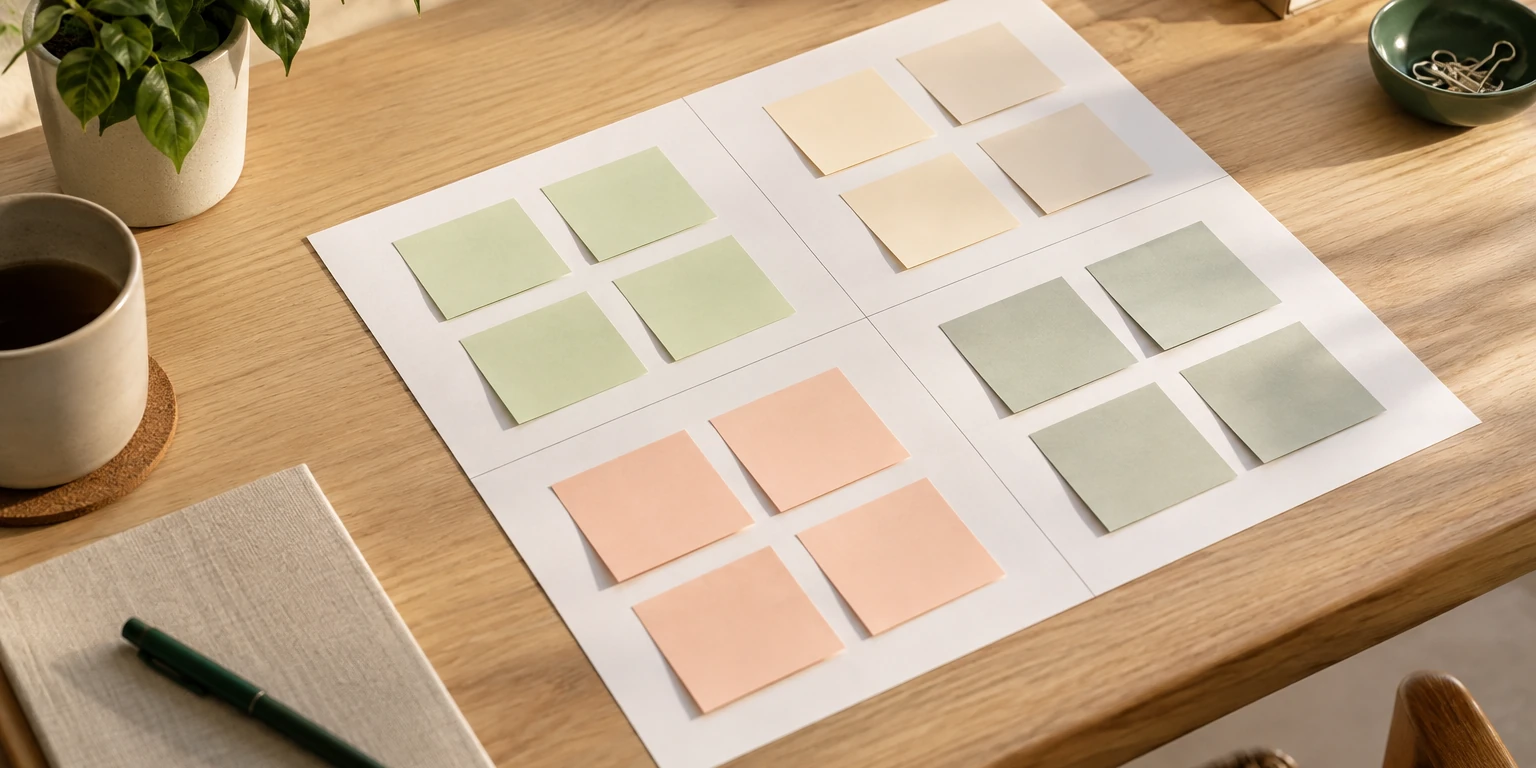
SWOT analysis (Strengths, Weaknesses, Opportunities, Threats) is a strategic tool used in academic research, class projects and theses in business, marketing and industrial engineering. If your professor assigned it, here's how to do it correctly.
What is SWOT analysis
It's a matrix that evaluates internal and external factors affecting an organization, project or situation:
| Positive | Negative | |
|---|---|---|
| Internal | Strengths | Weaknesses |
| External | Opportunities | Threats |
How to develop each quadrant
Strengths (internal + positive)
Competitive advantages, resources and existing capabilities.
Guiding questions: What does the organization do well? What unique resources does it have? What advantages does it have over competitors?
Weaknesses (internal + negative)
Limitations and internal areas for improvement.
Guiding questions: What can be improved? What resources are missing? What disadvantages exist compared to competitors?
Opportunities (external + positive)
Environmental factors that can be leveraged.
Guiding questions: What market trends favor the business? What regulatory changes could benefit it? What unmet market needs exist?
Threats (external + negative)
Environmental factors that represent risks.
Guiding questions: What is the competition doing? What economic changes could have an impact? What regulatory risks exist?
Presenting SWOT in your thesis
Option 1: 2x2 Matrix (most common)
Present the four quadrants in a table. The clearest and most direct approach.
Option 2: Crossed SWOT
Combines quadrants to generate strategies:
| Strategy | Combination | Objective |
|---|---|---|
| SO (Maxi-Maxi) | Strengths + Opportunities | Use strengths to leverage opportunities |
| WO (Mini-Maxi) | Weaknesses + Opportunities | Overcome weaknesses by leveraging opportunities |
| ST (Maxi-Mini) | Strengths + Threats | Use strengths to minimize threats |
| WT (Mini-Mini) | Weaknesses + Threats | Reduce weaknesses and avoid threats |
A crossed SWOT can turn a descriptive list into possible actions by relating internal and external factors. Use it when it answers the objectives or rubric, without presenting it as a university-wide requirement.
8-quadrant SWOT matrix (TOWS)
The so-called 8-quadrant SWOT, also known as the TOWS matrix, is the same crossed SWOT presented as a single matrix: the four descriptive quadrants (S, W, O, T) along the edges and the four strategy cells (SO, WO, ST, WT) in the center. Build it like this:
| Strengths (S) | Weaknesses (W) | |
|---|---|---|
| Opportunities (O) | SO strategies | WO strategies |
| Threats (T) | ST strategies | WT strategies |
In the header row and column, list the numbered factors (S1, S2, O1, O2…); in each strategy cell, write actions that cite those codes, for example "SO1: use S2 to take advantage of O1". That way the committee can see where each strategy comes from.
Common mistakes
- Confusing internal with external — Price is internal (you set it), inflation is external
- Being too generic — "Good service" says nothing. Be specific
- Not backing up with data — Each point should have evidence
- Listing without analyzing — SWOT isn't just a list, it requires interpretation
We include SWOT analysis in our research projects when the design requires it. Quote your project.
Need help with your research project? Our team supports you from problem statement to conclusions. Learn about our services.
Primary and academic sources
These sources support the editorial review of this guide. Always verify the current rules of your own program.
- Sistema de Educación Superior de Honduras, Dirección de Educación Superior
- Repositorio Tz'ibal Naah, Universidad Nacional Autónoma de Honduras
- Metadata Search and DOI Resources, Crossref

Need help with your project?
Our team can handle your thesis, research or technology project.