How to build an MVP for your engineering capstone
Reviewed: September 16, 2026. Sources, review and corrections methodology
DIRECT ANSWER
Step-by-step guide to building a Minimum Viable Product for your university engineering project. Plan, build and validate your idea fast.
Your professor just assigned a semester project and you need to build something that works. Not a polished product with every feature imaginable — a functional prototype that proves your idea is viable. That is exactly what a Minimum Viable Product (MVP) is, and learning how to build one is one of the most valuable skills you can develop during your engineering degree.
What is an MVP
A Minimum Viable Product is the simplest version of your project that delivers core value to users. It is not a half-finished product or a broken demo — it is a focused, working solution that addresses the main problem you identified.
Think of it this way: if your project is a food delivery app for your campus, the MVP is not the full app with payments, ratings and driver tracking. The MVP is a simple interface where students can browse a menu and place an order. Everything else comes later.
Why the MVP approach matters in university
| Traditional approach | MVP approach |
|---|---|
| Spend weeks planning every feature | Identify the core problem and build for that |
| Run out of time before finishing | Deliver a working product early |
| Demo a broken prototype | Demo a focused, functional tool |
| Professor sees incomplete work | Professor sees validated thinking |
Most engineering projects fail not because the idea is bad, but because students try to build too much. The MVP forces you to prioritize ruthlessly.
Step 1: Define the problem clearly
Before writing a single line of code, answer these questions:
- Who has this problem? (your target user)
- What is the specific pain point?
- How do they currently solve it?
- Why is your solution better?
Write these answers down in one paragraph. This becomes your project statement and will guide every decision you make.
Example: "Engineering students at UTH waste 30 minutes per day looking for available study rooms. Currently they walk building to building checking doors. Our system lets them check availability from their phone in real time."
Step 2: List features and cut aggressively
Write down every feature you can think of, then classify each one:
| Priority | Description | Rule |
|---|---|---|
| Must have | Without this, the product does not work | Build these first |
| Should have | Important but not critical for the demo | Build if time allows |
| Nice to have | Would improve experience | Save for future iterations |
For a semester project, your MVP should contain only the "must have" features. Three to five core features is the sweet spot.
Step 3: Choose your tech stack wisely
Pick technologies you already know or can learn quickly. A semester project is not the time to learn a completely new framework from scratch.
| Project type | Recommended stack | Why |
|---|---|---|
| Web application | React or Next.js + Firebase | Fast prototyping, free hosting |
| Mobile app | Flutter or React Native | One codebase, two platforms |
| Data dashboard | Python + Streamlit | Minimal frontend code needed |
| API/Backend service | Node.js + Express or FastAPI | Large community, quick setup |
| IoT project | Arduino + Python backend | Well-documented, affordable hardware |
If you are unsure which technologies fit your project, Folium Labs can help you evaluate options and set up your development environment.
Step 4: Build in iterations
Do not try to build everything at once. Break your MVP into weekly sprints:
Week 1-2: Set up your development environment, create the database schema, build authentication if needed.
Week 3-4: Implement core feature number one — the main thing your product does.
Week 5-6: Implement core features two and three. Connect the frontend to the backend.
Week 7-8: Testing, bug fixes and user feedback. Prepare your demo.
Each week should end with something that works. If week three's build breaks, you can always fall back to week two's version.
Step 5: Validate with real users
Even for a university project, testing with actual users changes everything. Find five to ten people who match your target user profile and ask them to use your MVP. Watch what they do — do not explain how it works.
Track these metrics:
- Task completion rate — Can they accomplish the main goal without help?
- Time to complete — How long does the core task take?
- Error rate — Where do they get confused or stuck?
- Satisfaction — Would they use this again?
Document your findings. Professors value evidence of user validation far more than a long feature list.
Step 6: Document everything
Your MVP needs documentation that covers:
- Problem statement — What problem you are solving and for whom
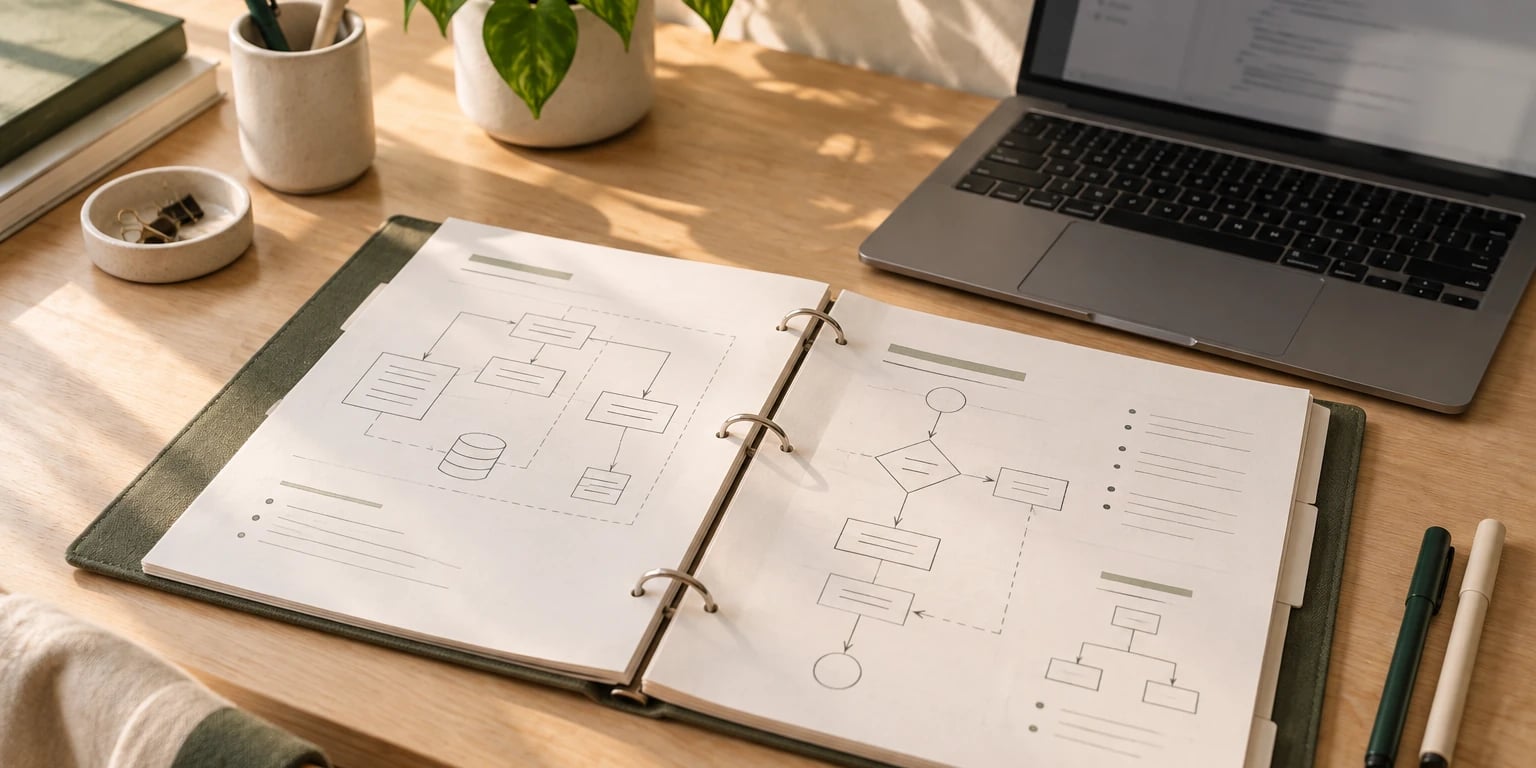
- Technical architecture — A simple diagram showing how components connect
- User flow — Screenshots or wireframes showing the main user journey
- Installation instructions — How to run your project locally
- Testing results — What you learned from user testing
Use a README file in your repository and keep it updated as you build.
Common mistakes to avoid
- Building features nobody asked for — Every feature should trace back to your problem statement
- Perfectionism on the UI — Functionality beats aesthetics in an MVP. Clean is enough
- No version control — Use Git from day one. Commit frequently with descriptive messages
- Working in isolation — If you have a team, use pull requests and code reviews
- Ignoring the demo — Practice your presentation. A great MVP with a bad demo still gets a bad grade
- Skipping testing — Even basic manual testing catches critical bugs before your presentation
Tools that accelerate MVP development
| Tool | Purpose | Cost |
|---|---|---|
| GitHub | Version control and collaboration | Free for students |
| Firebase | Authentication, database, hosting | Free tier available |
| Figma | UI design and wireframes | Free for students |
| Vercel / Netlify | Frontend deployment | Free tier available |
| Trello / Notion | Task management | Free |
| Postman | API testing | Free |
Building an MVP for your thesis or engineering project? At Folium Labs we help students plan, develop and deploy functional prototypes — from architecture design to a working demo. Tell us about your project and get a free quote.
From MVP to final project
Your MVP is not the end — it is the foundation. After your initial demo, gather feedback and decide which features to add next. This iterative cycle of build, measure and learn is exactly how professional software teams work, and demonstrating this process in your project report shows your professor that you understand real-world engineering practices.
The best engineering projects are not the ones with the most features. They are the ones that solve a real problem clearly and prove it works.
Related guides: How to create a landing page for your university project, UML diagrams guide for university students and Git and GitHub guide for university students.
Need technical guidance for your engineering project? Learn about our software development services and get expert support from planning to deployment.
If this is part of your capstone, see which deliverables a systems engineering capstone usually requires and download the software documentation template.
Primary and academic sources
These sources support the editorial review of this guide. Always verify the current rules of your own program.
- MDN Web Docs, Mozilla
- Web Content Accessibility Guidelines (WCAG), W3C

Need help with your project?
Our team can handle your thesis, research or technology project.